Episode Transcript
[00:00:00] Speaker A: I don't think AI is about technology change and transformation. I really think it's a leadership transformation. At the end of the day, the higher level you get, including in this job, the less you hear.
So you've got to create an environment around you where people feel like they can take that risk, if you will, and, like, speak up in the right way on what's going on in the. In the environment.
Every single person is different. You can't leave people behind on the field. You can't make it okay that no one ever gets any playing time, like, ever. You know, everyone is on the team for a reason.
I believe in collective intelligence, because if you unlock and leverage everyone's different skills on the team, you inevitably reach better outcomes for the customer, for our colleagues, for shareholders.
Every leader has defining moments, decisions, challenges and experiences that shape not only their careers, but the way they lead others. Welcome to Lessons from the Field, a podcast from the Chro association episode. We sit down with today's leading chros and business leaders to explore the lessons they've learned throughout their careers and the insights that continue to influence how they lead organizations and people.
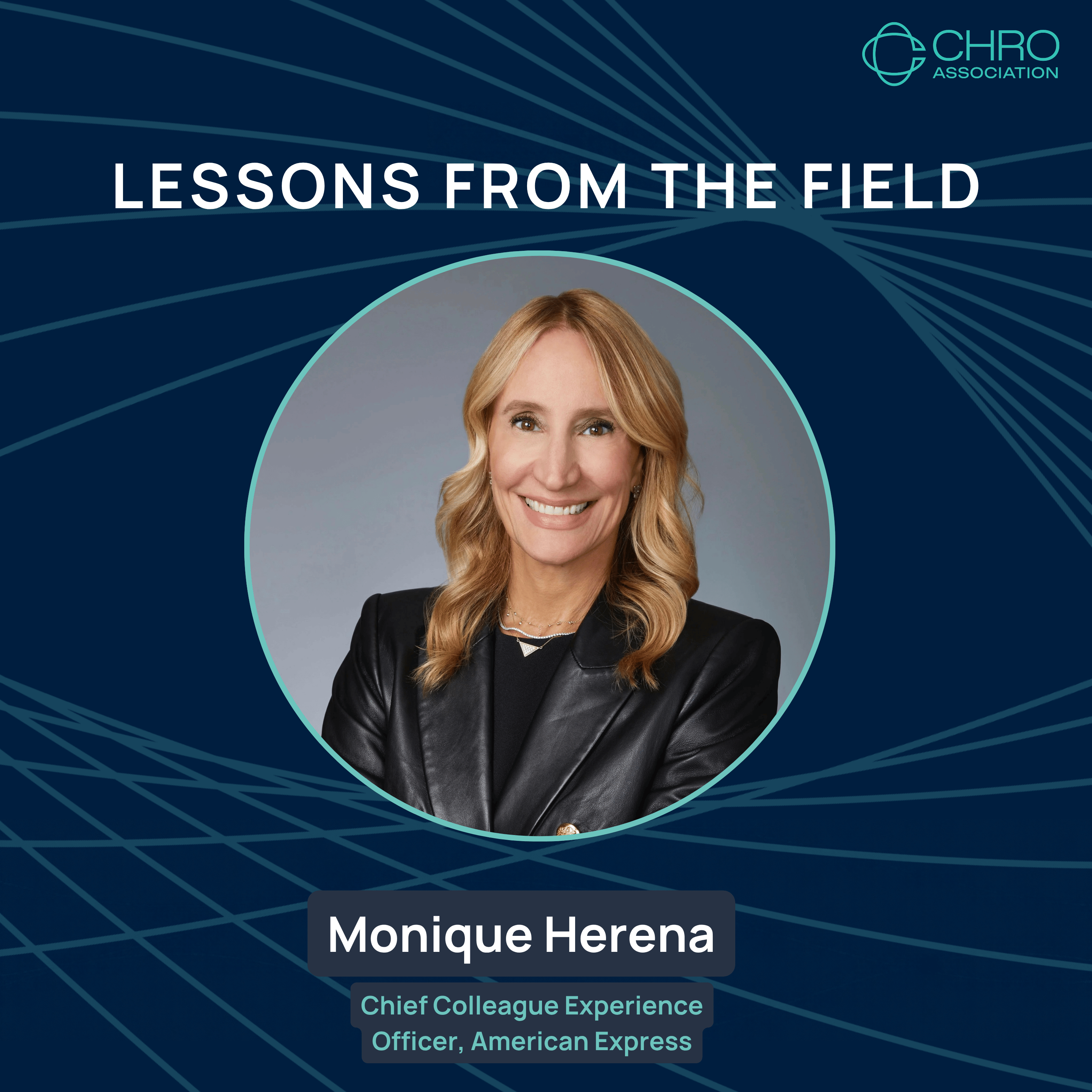
[00:01:18] Speaker B: Today, I am super excited to welcome Monique Herena, Chief colleague, experience Officer, American Express, and the longest serving member of the Association's executive committee.
Monique, welcome to the podcast.
[00:01:33] Speaker A: Hi. Thank you, Tim. I'm excited to be with you. I'm very happy to be here.
[00:01:37] Speaker B: Tell us a little bit about who Monique is. Kind of the version that your closest colleagues would know but may not come across in your polished discussions in the corporate setting.
[00:01:50] Speaker A: Yeah, I think a lot of what you hear would be a ton of consistency around really four things. And I am pretty sure as long as we've now known and worked together, Tim, these might even resonate with you quite a bit. So I think the things that I hear the most consistently one is that I'm a business leader.
So I do happen to be the chro. I've been leading HR and working in HR for a long time now, like over 30 years. I've been almost 13 years as a chro.
But I'm really a business leader first. And I think everyone would describe me that way on the business side and in the HR organization, because I really try to lead and live the mindset that our role is really to accelerate business growth by making sure our people and our talent strategy really enables and fuels our business strategy. And the only way you can do that is really by understanding the business, you know, weighing in on all aspects of it, to really ensure that we have the talent now in the future are competitive enough with our colleague value proposition, as we call it to really make that all work and come together at every level of the company. So I think that's the first is like, I'm a business leader.
I talk that way, walk that way, and yes, I lead hr. And then I think the second thing you would hear without question is I'm very tough. I have a very high bar for myself in terms of performance and the team. But I'm very fair. I'm very well respected. You know, I'm a Midwesterner by upbringing, so I really live through the lens of my values on every decision. But I have a really high bar. I feel like we need to deliver for our customers, for our shareholders, for our colleagues and each other at a really high level of performance. And I think the only way you can do that is by leading through example. Me and my team and our executive team.
And that type of standard is what we should strive for every day. So I think you would hear that often as people describe the real me and what it's like to work around and with me. And then the third is I'm a change leader. I often say that I agitate a lot for change on purpose.
And the reason I do that is there is not a lot of learning or depth in success. I think there's all the learning and all the depth of those learnings in times of challenge and when you're working through hard things individually and as a team. And I'm sure everyone who's listening can relate to that, but you have to really lean into it because the default way of operating is your comfort zone. The default way of operating is avoiding change. And that's when we grow the most. That's when we do the best things for our customers and each other as colleagues. So it's really in my mind HR has an even higher standard around change, leadership and courage because we have to help the rest of the organization lead through significant change or even minor moments of change. And the last thing I would say is I'm very team oriented. I grew up playing sports.
[00:05:06] Speaker B: So what did you play?
[00:05:07] Speaker A: I played basketball, predominantly. I played a lot of different sports, but basketball was my sport. My dad was even my coach for a while. My dad was a high school teacher and a coach.
And I think that unlocking the potential of a team and the power in that is really important. And I learned very early in my career, mostly at PepsiCo, from a lot of great leaders in our profession around the focus really not Being on you, about it, being about everybody else and how they come together. And as a leader, how were you performing? How were you developing others? How are you promoting others? How are you creating the environment where not just you would win, like, great, but who cares? How does the team win? And how does everyone want you on their team or leading their team because of what you're developing in others. So not just the strong results, but like how you're doing that as a leader and how you're making people feel in the environment. So I think that's the, the fourth area you would hear is like very team oriented.
[00:06:09] Speaker B: You've mentioned this before, talking about team, talking about it not being about you. We all at some point or another think it's about us. I mean, how do you get to the point when you're beyond that and how do you get others to see that as you're.
I'll call you, based on what you just said, the agitator in chief. But to get them to see that they have a role to play on this team and how do you communicate that with them and how have you learned about that in kind of rising above it?
[00:06:42] Speaker A: Yeah, I've learned through evidence and experience over and over and over again. So the evidence of the experience is I believe in collective intelligence because if you unlock and leverage everyone's different skills on the team, you inevitably reach better outcomes for the customer, for our colleagues, for shareholders. If you try to be someone who knows it all, focuses on yourself, is not collecting that intelligence in a way that really sort of informs different solutions and scenarios as the team is planning to make decisions and execute. I just have seen it be suboptimal. And as I've then coached other leaders, as I move through my career, I see a gigantic difference between those who value the input of others, value the input of kind of data driven research.
And really kind of tapping into that and really knowing your team and your people well enough to unlock their potential. Because every single person is different and you can't leave people behind on the field. You can't make it okay that no one ever gets any playing time, like ever. You know, everyone is on the team for a reason.
And I think it's really important to focus on that. Everyone has an ego, everyone wants to be successful. But I really have seen it play out in my career where the more I'm focused on the team achieving great results, the more comes back to me a hundredfold anyway. So I think that orientation is like really, really in my mind, almost like a proven Fact, at this point, I
[00:08:29] Speaker B: wanted to connect a couple of your four points you just talked about. Let's start for a second with business leader and say, okay, you know, you have been in a number of different companies. You actually started, I think, in. Was it in search? Is that kind of where you started?
[00:08:48] Speaker A: And did executive retain search and management consulting? So they did both.
[00:08:53] Speaker B: As you added to your bag of tricks through your career, through your assignments, how did you continue to refine the business acumen part as you were doing your role? Because I think we hear a lot about those in HR leadership roles and sometimes they have that broad perspective like yours, that's business focused, and other times they are honed in on the function, but not as broad. I mean, how did you continue to expand the aperture as you went through?
[00:09:24] Speaker A: Yeah, it's a really good question. I think the latter, like honing in on the function and not thinking broad, as you put it, means you're not doing the job. It's almost impossible. So you cannot do any functional role, finance, hr, legal, et cetera, while being zoned in on just functional excellence. That's not enough.
You are part of a business team. Speaking of collective intelligence, you're part of a total equation.
So to not operate in your role, in your space as part of the context of the business, to me, is not the right mindset or model. So the way you do it is you always think about what are we trying to achieve as a business, what is our strategy, what's our plan for the year? And then how does the talent strategy, the culture strategy, stem from that? To either reinforce success, or if you're doing things that are detracting from it, or you're focused on things that worked for you in the past on the talent side, but they're not moving you into the future, how do you make those adjustments? So to try to do that out of context of the business and what we're all here for, at least at public companies, which is to generate shareholder value. I don't know how you do the job well, so they're so. I'm such a systems thinker. They're so interconnected.
And I think that there's this thing that happens with HR folks where it's like, it's really hard to learn the business. How do you do that? Whatever it is not.
You're living in the business day in, day out, you're attending meetings, you have all the public information and internal information that your colleagues have. And it's like a you get what you give game. So you have to really apply yourself to putting everything in context and then leading by example with your peers around the executive table, but also with your HR team.
[00:11:10] Speaker B: Go back to your, I don't know, your Pepsi days or others.
You had a role, but you were engaging with others. Does anything come to mind about kind of an example where kind of the business impact really came to mind for you or was particularly obvious is how, you know, in your systems thinking way, everything kind of connected.
[00:11:34] Speaker A: Yeah, well, so I'm going to be a little bit dramatic to make a point, but it's absolutely the truth. So there a time I can think about where I was leading something really significant for the organization where that lens didn't play like one of the greatest parts in the success of what we were all doing. So it could be when I used to focus on labor a lot and I was negotiating a Teamsters contract, I was working with my comp folks, the business folks. What could we afford? What could create the environment that we needed to create for the business to be successful? And how did that all come to bear so we could have the right contract that would be agreeable, but that also helped move the business forward and didn't lock us in one way or the other. It could be a merger. I worked for Allied Signal when we bought Honeywell and took their name.
And I was playing a big role in the talent strategy and also what, like our intranet felt like and what the new combined company would feel like for colleagues. And in creating that, it was really about the vision and the strategy of the CEO with this new combined company. And, and how we could bring that to bear for employees day in, day out. So that's another example. I had an activist that was on our board and I had to lead through significant change with the management team. And that was really all about transforming the business. And a big part of it, again, was talent, culture and performance.
And so at every turn, there's nothing I haven't led for where it's not been obvious that I still have to check myself and make sure that we're doing the right things that are actually connected enough to see a difference versus hr kind of over to the side. I call it working on some hobbies or things they think are interesting, but they're not really driving the business forward.
[00:13:23] Speaker B: They're not driving. Yeah. And it's interesting to me, and not surprising, but interesting, the number of your colleagues who have had an activist at one point or another, and you realize how much that hones attention on the fundamentals of the business, whether you like it or not. And it really. It's lessons for many of them. So I think that's a. I think it's a great idea. But I want to go back to what got you interested or led you to HR in the first place. I mean, I love it. The fact that, you know, as am I, we're both from Wisconsin, so you've got. You got to get Midwest roots, family atmosphere. I know just from our conversations, how the heck do you end up as the chro of.
Of a Fortune 100 Kofi?
[00:14:11] Speaker A: Yeah. How do you end up that way? It's kind of crazy, right? So, you know, upon reflection, I think a lot of our listeners that reflect will have the same story or a similar story to mine, which is I really stumbled into hr. I definitely didn't even know what human resources was. I didn't sit around as a kid and say, I really want to be the CTO of, you know, a large company.
Had no idea what that was. So when I first, you know, kind of finished undergrad, I went straight to get a master's. And what I thought I wanted to do, which was to be a professor and to write and teach, which both things I really, really loved. And it was sort of this, like, esoteric area kind of adjacent to philosophy and rhetorical criticism. I probably should have ended up in D.C. or something with what I was studying. And I thought, while I apply to my PhD, I'm also going to apply to some jobs and, you know, make some money and, you know, kind of see what happens. And that's when I got this consulting role where they did the neck routine search and also consulting engagements with big pharma in the Midwest. It was mostly Baxter, Abbott, Dade International.
And they were really transformation efforts. Some of them had to do with search, some of them had to do with change. And I was making really good money from, like, making nothing but my teaching assistantship, you know, like, you know, stipend in graduate school. And that meant for me, given the way I grew up, a lot of independence. I ended up moving from Wisconsin to downtown Chicago. I really liked what I was doing. But along the way, I started noticing that when we would pitch business, and I was doing that way before, I probably should have, but I had some people who had a lot of confidence in me at that firm is we had a cfo, we had a CEO, and sometimes we had the C Trojans. And I was like, boy, that job is really interesting. So I was intrigued, but still not thinking I'd go anywhere near it. And then I was working at the same firm and one of my girlfriends wanted to go out after work and she wanted to stop at a career fair on the way to where we were going out. And I thought that was a pretty dumb idea, but I really liked her and I wanted to go out with my friends. So I went along with it. And I didn't have my rent may or anything. And this is, you know, before the days of even like Monster.com or any of the job boards. So we had like career.
[00:16:31] Speaker B: I love it. We actually went to.
[00:16:32] Speaker A: Yeah, actually went to a fair job ads career. You know, this is like dinosaur times. And so we went and I was kind of standing by the doorway of this like ballroom, like not engaging because I didn't have any paper, you know, resumes or anything with me. And this guy comes over from the Quaker Oats booth. This is pre PepsiCo owning Quake. They were maybe like a $4 billion firm. And he starts talking to me, what are you doing here? Whatever. And he says at the end of the conversation, you know, I think you'd be great in hr. I think you'd be great in recruiting in particular. It sounds like you've helped start this firm that's doing some of that. And I think, you know, it'd be a really great entry point into you for like a more corporate environment. And I was like listening to him, but I remember so clearly of like, this guy is like crazy. Hopefully he stops talking like sooner versus later. Like I'm standing here with him and he gives me a card and he said, you know, I'm gonna, I'm going to contact you. Can I give you one more card and you give me your contact information. So I did that and they called me right away for an interview. So I interviewed at Quaker. I thought, what can. What is there to lose?
And I got my first HR job and it was in recruiting. And it was everything from like campus and pipelining, entry level recruiting through executive.
And it was a pretty big job for that size firm.
[00:17:52] Speaker B: I was gonna say, when you get it up to executive, that's a pretty big deal.
[00:17:55] Speaker A: Yeah, yeah. So I was learning the business right on tight. Cause I was very interested in fast moving consumer goods because they were so relatable. You know, you knew Quake, we had Rice, a Roni at the time, Gatorade, et cetera. But what I loved about it is that, you know, you've got kind of this art and science that's always a part of human resources and the art part of it Is like you're connecting with so many people that are interested in joining the company and potentially changing their lives, their livelihoods, the lives of those around them by maybe a better job, more income, a career path that's more long term. And I thought, wow, this is like a huge responsibility and really cool to be representing the brand and the company and the culture in this way. And right on type. Since you know me, Tim, I had, you know, five, you know, observations and suggestions of the way we should do things differently, you know, like per week. And I was always coming up knocking on my boss's door with like solutions for that. And so I very quickly got promoted at Quaker a few times and that became a little bit too small of an environment for me to grow. And that's when I went to Allied Signal. But that's literally how I got into hr, was through this career fair on my way to going out with friends.
[00:19:08] Speaker B: So this agitator mentality has always really existed all the way through in childhood.
[00:19:14] Speaker A: If you talk to my parents, I'm sure it was like quite annoying. Yeah.
[00:19:18] Speaker B: So let's talk about that though for a second. So your dad was a teacher.
Was your mom a teacher as well?
[00:19:23] Speaker A: Yeah, no, she was not. So my mom, my mom moved over here from Italy at a pretty late stage. Like they had gone back and forth a couple of times that she officially started living here full time when she was like a junior in high school.
[00:19:39] Speaker B: Oh, wow.
[00:19:39] Speaker A: Yeah, it was like quite late and quite a transition as you can imagine.
So she didn't know what she wanted to do and it was a little bit more old fashioned of a mold at that time from my grandparents, et cetera. So they had a restaurant which I worked at from a young age. Great kind of example on both sides of the family around work ethic. But first she thought, well, maybe I'll be. At the time they called a beautician, like a hairstyle. Yeah, yep, I'm going to do that. So she ended up doing that and being the manager of her salon and kind of doing that. And then she eventually ended up in real estate.
So she was like a real estate developer and broker. So I always loved like decorating her and my dad used to build and flip houses as like another way to, you know, kind of supplement the, the teacher salary, et cetera. So yeah, that's what she did. But so everyone was always working around me. Like education was a focus, but I would say not as strong of a focus as even the work ethic was, is just to like be Busy, stay busy. You know, my dad and I would always be getting up early on the weekends and like, thinking of projects and stuff. And he was always looking to me for like, ideas on like, what we could do differently. He was big on world events and current affairs and so we'd talk about a lot of things and he would ask me how I would handle things. So I think there's like a lot of confidence that comes from being asked what you think and then being able to come up with new ideas and implement them and see if they work or if they're a really bad idea from like a young age.
[00:21:10] Speaker B: You know, it's really interesting, isn't it, the way that our family situations shape us and then how they manifest themselves about, you know, I can think about you asking questions, whether it be in a board meeting or in a conversation or to your point, about being tough, not being satisfied with an answer because you know there's something else there. Yeah. But knowing that it comes from a place of wanting to make it better. And that's where it's really interesting. If you were having that conversation with your dad about, okay, how would you handle. That's actually a fairly almost pure kind of conversation when you think about it.
[00:21:49] Speaker A: So it's going to be from his dad too. So it was like a generational thing. His dad was a firefighter, but he also was very like, handy. So he did a lot of woodworking stuff around the house. My dad was like his young apprentice. Even though I think most of the time he didn't want to be, it rubbed off on him. And, you know, whether we would go fishing or we were doing a project in the garage or whatever I was doing with my dad, you never felt judged for asking the second, third, fourth order questions or making suggestions. It was all about the learning process and kind of, you know, trying something. If it fails, it fails. And we learn from that too. So I think that kind of environment growing up, or even when I worked at my grandparents restaurants, you know, like little things I would do here and there. It was nothing all that serious to me. It was like everything because I got to be around them. And I would suggest, you know, well, what if we did the salad prep different for dinner this way and we arrange the train that way. And so there's just always, I think, room. I think about this sometimes with our interns. Like young people can do so much more than we think. Like their capacity to look at things objectively and like, question without, like, judgment. As long as you said it best, people Know, you're coming from a place where you just want the organization and them to be more successful. It's not a judgment. It's more like a continuous improvement type of vibe.
[00:23:10] Speaker B: We often put people in roles instead of looking at capacity, ability, or interest.
You know, if we can get beyond our own stereotypes, we can unleash a lot. Yeah. Just to that point, did a little bit of research, getting ready for this. So just. Just a little bit. But. But one of the. And yeah, I think you said this on the chairs forum too, but you said that you learn something from every person you encounter for you.
And let's go beyond immediate family.
Who was the first person where you really remember that resonating for you?
[00:23:44] Speaker A: I'll pull it through to the professional life. But I remember even as a kid, I thought everybody's story of, you know, how they got to do what they do, the role that they played in whatever organization I was a part of. So even I remember as a teenager working different jobs and retail, et cetera, because I always liked to make my own money. I thought that was like the coolest thing. And I remember thinking, what makes someone tick? And how did they get to this place? And how are they doing a good job and being a dependable employee with more or less sales? And how is someone else doing the same role, not getting as much out of it, not bringing as much evil? So I think, like, almost like from like a psychology and sociology standpoint, I'm just so interested in people and all people, irrespective of, you know, rank or tenure or back. And like anything, I'm just so interested in everyone's story and sort of how that comes. How that comes to life through their life and, you know, et cetera. So I think that in a professional sense, I'm always looking for the people. I think you can tell I'm an extrovert after how many years we have work together.
[00:24:55] Speaker B: Tim would never have dawned on me.
[00:24:59] Speaker A: Yeah, I'm always looking for the people who maybe, you know, have a ton of expertise, are closest to the task that we're trying to solve, and maybe aren't heard from enough. So sort of bringing them into the conversation or bringing different people into the conversation that may not be in the room, but should be. So I think that's one of the things you think about, is there's no way I know everything, and there's so many people that are so much closer to whatever the issue is we're looking at.
So how do we bring that to bear as we're solutioning. And I think if you have a respect for everyone and the role they play and how special that is in creating better experiences for customers, for colleagues, et cetera, you want to naturally, like bring in different angles and kind of push the thinking in the room with different perspectives. That usually at this level is a lot more interesting and a lot more relevant than anything we have to say.
[00:25:50] Speaker B: Yeah, I've seen you do that and kind of reach down below, sometimes below. And just as you did just here, you do it in such an earnest way.
Just let's bring this person into.
It's almost like a talk shadow and kind of blow by any of the social constructs that you run against in a corporate environment.
Think about that for a second and think about personal impacts on your own leadership. Is there a moment or a person that genuinely changed how you look at leadership?
[00:26:31] Speaker A: I think I've had different lessons from each place. I've taken what's so cool about working for different people. If you think of it this way, it's really a mindset that you get to take choose or not, which is I'm going to learn what I would do that I really like and take little bits of this person's sort of leadership style and impact and I'm going to not take what I don't like. And I felt like, you know, in my mind, if I ever get to a place where I might be in a job like this with that much impact or that much leadership, I would not treat people like that or I would treat people like that or, you know, I would. I would just lead in a different way, maybe bringing people along more than that person did or whatever it might be in the change. So I think that you can learn from everyone, like even the worst of the bosses. So in each place at Quaker, remember, Gatorade was a really, really big business at that time and growing. And in fact, you know, we had an office for Michael Jordan in our building. It was the heyday of the Bulls in Chicago. And so you were like surrounded by excellence and helping to fuel excellence. And that was really part of the mission. And then part of it was, you know, health related with Quaker and, you know, that kind of thing. So it was a really cool environment to think about how what you did mattered in terms of, you know, kind of what the products, you know, solved for customers. And then I think when I went to Allied Signal, which again became Honeywell, and it was a totally different industry and I remember being really inspired by a totally different set of people, you Know, not necessarily marketers and general managers in the consumer goods space, but more, you know, people who had been an aerospace engineer their whole life was now, you know, leading a business, et cetera, and very technical. A lot of engineers there, a lot of government contracts. And you learned about the cycles of leadership and how you treat people when you have a government contract that might disappear and then come back and, you know, how do we kind of flex the workforce? And I learned across the table negotiating with Teamsters and some really tough guys in this case made me equally tough to be able to show up as a some year old HR person and find a win win. And, you know, then you get on to PepsiCo and I had nearly 15 years there of just constant learning about how the competition and the intensity of the competition, of being a little bit of a number two, really that heat at your neck of not losing a share point and kind of being a leader in food and beverages and waking up that way with that hunger every day really makes you a different kind of leader in terms of not wasting any time, not wasting a moment in terms of what you focus on, what's not important. And it's okay to leave aside.
I think Steve Reinemann, who was one of the CEOs and Indra Nui had a really significant.
[00:29:35] Speaker B: I know Steve. Yeah. Steve actually spoke. Yeah. As you know, spoke to our group.
[00:29:39] Speaker A: Yeah, yeah. Amazing guy, former Marine. His father died at a very young age. He had to help raise his brothers.
Really exceptional person, values wise, but also a very high standard for himself and the team with leadership. And Indra, the same thing. And so, you know, you learn this sort of way of leading with this high bar on excellence, but also bringing people with you in the right way, recognizing them when they do something great, but also giving feedback when it's not great. Because if everybody's great, no one's great.
[00:30:08] Speaker B: So just with that though, does any. Does any anecdote come to mind from. Yeah, you know, whether it be Steve, Indra, even at Quaker. Was there something that just kind of seared in your brain about leadership? Because all of those are great and actually synthesize nicely across how you put these experiences together into who now is Monique. But help our audience a little bit if you have an anecdote that sticks out in your mind.
[00:30:34] Speaker A: Great question. I've got a couple. I've got one from Steve and then Reineman and then I've got one from my current Steve, who's Steve Squery, the CEO of American Express. So I'll pull it to the future. But Steve Reinemann, I can remember and we've talked about this story when I sent him an email late on a Friday night for a project he had asked me to leave for the company so across the enterprise to basically develop a high potential rotational program.
And I had a team of about 30 people globally that were like my advisors to designing the program. It was going to have his sort of name and brand on it as the CEO's program, a general manager development program.
And I thought something we were doing was really not the right way to go. And I felt really strongly about it. And I had all my data and all my facts and all the people I had talked to and how it would be positioned in the market and. And he really wanted to do that particular piece like the most.
[00:31:31] Speaker B: Always works that way, doesn't it Monique? It always works.
[00:31:33] Speaker A: It's like junior me. So I sent the email. I remember saying to my husband like on Monday I may not have a job, but I did the right thing. And I sent him an email because I really want him to reflect on all the things we're doing right. But I think we might be making a mistake. And I want to hear what he has to say. And I felt like no one else would tell him so. So I'm leading the project. Let me represent this and I believe it. And he responded to me that night when I woke up, I got the email and he said, you're 100% right. Thanks for having the courage to raise this. I think we would have made a mistake x this piece. Let's keep going. Great job. And it just. That anecdote is never be afraid to speak up. If you never ask, the answer's always no.
Don't go to sleep at night as an HR person without the courage of telling someone what you think. At the end of the day, everyone has a boss. He was the boss. They're going to make the ultimate call, but you really want to make sure they have enough perspective. And I think the higher level you get, including in this job, the less you hear.
So you've got to create an environment around you where people feel like they can take that risk, if you will and like speak up in the right way on what's going on in the environment. So that's one. And then I led through, you know, unfortunately, unfortunately the pandemic and I saw someone where we were just in lockstep nonstop, always doing the right thing for our people first.
And that manifested itself in things like no pandemic related layoffs. So People could focus on our customers and they were already having physical health challenges, either themselves or in their households. We didn't need them. Compounding with the mental health challenge of do I have a job or not?
So we stuck to that. We over invested in our customer and our colleagues where a lot of people were pulling away investment at that time, including in us really reinforcing and adding funding to our mental health offerings for households. That made a really big difference. And I think that moments like that, when you see a leader, it doesn't matter if it's a good or a bad time, your values are the same. We call them the blue box values. At Amex, we were putting colleagues at the center because they were the ones taking care of our customers, having our customers back as our customers were going through their own trials and tribulations. So we always say the best way to have our customers back is to have our colleagues back.
[00:34:05] Speaker B: One question before I move on. It goes back to your first example of the leadership development program.
You had the guts, but you also had, I'm going to assume you had the credibility to question how do those two go hand in hand in your mind? How do you develop the credence or the capital, if you will, the leadership capital to be able to disagree effectively? And how do you build that up over time? Because the two seem to sometimes go hand in hand. I think. Right.
[00:34:40] Speaker A: At the risk of sounding super old school, I think it's 100% the truth, which is the only thing that gets you in the game, keeps you in the game, continues to earn your seat at the table. To be able to have a point of view that is valued is results, hard work and results. So you've got to know your stuff, but you also have to weigh in frequently and apply what you know in a way that you know gets you and your team great results. And when you're seen as that person, people want to hear from you. So even if you're offering it up and you've built the confidence to offer it up, people are going to pull on that more and more, whether they agree with you or not. They're interested in your perspective because they know that you know your stuff. You weigh the facts, you weigh the information, you do some analysis, you talk to others, you've got an ear to the ground and you bring all that together to weigh in and not just when asked, but proactively hear about the company and the shareholders. And I think that, you know, you become a go to for counsel. And I don't think you Wait to be that person. I think you start as early in your career as possible, and some people are comfortable doing that in the room, outside of the room, both through an email, through whatever it is, make sure that you're, you know, you're doing that.
[00:36:02] Speaker B: I want to talk a little bit about.
It's not about the sacrifices, but it's about the different things you do as you build your career. And particularly, oh, the places you've gone. Somebody was mentioning Dr. Seuss the other day, so I. Oh, the places you'll go. But when you think about Dubai, the Bahamas, Chicago, Arizona, New Jersey, New York, you called the moves the highlight of your career. And all of those that have impacted you along the way, did any of those almost break you or any of those particularly difficult?
And how did you handle it? I mean, how did you go through that?
[00:36:38] Speaker A: So I think that there's a few things that sort of ring true, whether you're thinking about moving for one role or just continuing to sort of challenge yourself in things that are very different. Is the really amazing thing about growth is that we grow exponentially when we're in a very, very different environment. And if you stay in the same environment, could be the same environment you grow up in, then you have to inject enough to change into whatever it is you're doing to, you know, hopefully continue to grow and not get complacent. And I think that in my case, I was very sure with myself. And then what became my home team first with my husband, you know, 27 years ago, and we have three amazing kids. We had agreed that we were like Team Hrena for both of our careers and for our family and not just for, for then, but like for the long run of how we wanted, you know, kind of our family to run in terms of the home team. So we already knew and discussed often which trade offs we would be willing to make and which ones were just a step too far. I also think that for many of the moves, I had really amazing mentors and sponsors and bosses who were like, these are the types of things that could come next.
This is why, because we know that you get international to be competitive for the Chro bench or whatever it might be. And here's the one or two jobs that we may call you for. So, you know, think ahead. Where would you say yes, where would you say no? And so that gave us the chance to sort of plan and decide what would be aligned with our values and, you know, where we would trade off and where we wouldn't. And I Think my husband and I both love change, which is quite unusual. So it's lucky we found each other. You know, I think that we're like adventurers and we're learners. So, you know, we didn't really have that language of like breaking or at the time, like making trade offs. We just knew what sounded exciting and like growth for me, for my husband, for the kids, and what sounded like something we just wouldn't do just didn't sound right for us. So that made those decisions pretty easy. And then if you have that growth mindset, you have sort of this frame where it's like, we're only going to be here for so long. The kids are only going to be here so long when they were part of. So how do we make the absolute most knowing that someone could call us and say, hey, you need to move back to New York from Dubai. And so we really did, you know, culturally, food, language, traveling. We really made the most of it, you know, for all of us. Because everything in life, as you get older, you realize how fast it goes.
And so we really.
[00:39:29] Speaker B: It does go fast.
[00:39:30] Speaker A: Leverage it. Yeah. So I think it's like, listen, if that's not the right thing for you to move geographically, it's like, how do you really ensure, like the roles you do are stretching you and you're not rechecking the same boxes. So if you want to be a chro, you want to be whatever, how are you sort of creating a mix of experiences that make you more competitive on a slate for that? And that's really the way I thought about it.
And we don't regret any of our moves.
[00:40:00] Speaker B: I think it's very cool and I think that people who can do that well as a family, I think it's getting harder because fewer people are moving, so the expectations are there. But to have that and to have it in a family bag of tricks, to have memories from places you've been as a family, sounds pretty cool.
[00:40:17] Speaker A: That's been cool often.
I'm the coach though, to a lot of people where for anyone who's relocated, who's listening, you have the public Persona of that, which is you're at your new job in the new city, the new country. Then you've got people at home trying to figure out how to drive where, how these new schools work, the right clothes, all the emotion that goes with it, and it all settles down. But change is change.
It builds up a lot of resilience in the family and in the person who's doing the new role in a
[00:40:49] Speaker B: New place I want to go to AI, but before I do, I have to talk. You mentioned teaching earlier when you were at bny, you went back to teachers college at Columbia and you were fairly far along in your career and yet you were getting this graduate degree. And I mean, talk about that a little bit. What led you to it, what learned as a result of it. And there's a giving back component as well.
[00:41:16] Speaker A: Yeah, yeah. So it's pretty insane when, when I explain it to someone what I did. But I did it, so I'm very proud of that. So I was in my 40s already. I was the sitting CHRO of BNY bank of New York and you know, reported the CEO, had an activist on my board, was really busy and you know, had a large team and we were in the midst of turning around the company and I kept having this nagging feeling of like it would be great to at some point study what I actually do for a living directly.
And I'm so interested in continuing to learn in this space. Mostly individual and organizational psychology is where my like true passion really lies. That ties a little bit to my PepsiCo background, a lot of the people that I had working for me, et cetera. And so my daughter had finally, my youngest of the three, I have two boys and a girl.
She had finally gotten to the age where I felt like maybe, maybe I think she just turned 10 or something. Like maybe I could like pull this off if there was like a nighttime program or something. So I started researching in the New York area. Cause I obviously had to be in the New York area with my big job. And I found this program at Columbia that was four executives, a fully accredited full master's that you could do full time over a year in four week, full week increments on site.
And it was at Columbia and it was in change leadership and organizational psychology. So it was a mix of individual and organizational and change leadership. And so I talked to some of the professors there and they encouraged me to apply. And I remember going into the then CEO's office and saying, I'm thinking of applying to this program.
If you don't want me to do it, I won't. I know we have a lot going on, but I will not miss a beat. I will be online every night. You know, we have day long classes and I will like make it work if I can do it. And I remember he like slammed on his desk and he's like, you have to do it. And I was like, what do you mean I have to do it? He's like, what a great example. It's so you of just like continuous learning at every stage and who cares if you're in the C suite. What a great example for your team. And you can bring back the learnings to the executive committee and your team and it'll be fantastic. So I'm sitting there thinking, well you know what, now I gotta get in. Like, oh my God, like what if I don't get accepted?
Is Columbia. So I applied, I was accepted. I told him I wanted to pay for the full thing myself. He'd said I should do the tuition reimbursement. And I thought at this level that just doesn't feel right. So did the program. Don't ask me how did my full time job quite well and really loved it because I love writing, I love reading, I love being in a learning environment. I think I got so much energy from it. I shared all the learnings with my team to, you know, help make us better as a team. So I absolutely loved it and I love the program so much. And you referred to it as. My husband and I started a family scholarship fund basically for change leaders who are looking to pursue their MA and their PhD in this space of kind of organizational change. Leadership in cross sectors. It could be government, it could be corporate, it could be in education.
That was something that we were really passionate about. So I've met a lot of our recipients and they're like amazing researchers and human beings and really contributing a lot of cool things. So it's been very rewarding.
[00:44:46] Speaker B: You have been very generous to share your relationship with Steve Squery and had him before our group at one point.
I know he made an announcement in the annual report this year and in his letter talking about how American Express is looking at AI. And I know that you are integral to that role. Do you want to talk just a little bit about how you yourself have learned to integrate AI into what you do and then you can talk about the organization too. But I'm really interested in how you have become smart on that. I'll be candid. I'm still on my journey. I'm there, but I'm still learning daily on it.
[00:45:28] Speaker A: Yeah, so we, I think like every company are, you know, very focused on everything from, you know, automation through AI, through generative, in a lot of cases, applying it to our business. Specifically when you think about agentic and everything that's going on with, you know, payments and shopping, et cetera. So we are like all in fully involved. We have been a leader in, you know credit protection and trust for decades and decades and decades, serious into machine learning for like over 15 years. So we have, we have a lot more experience than you may just logically think about in terms of sort of building, you know, sort of out of transformation outline of what that could look like for the organization. But I don't think AI is about technology change and transformation. I really think it's a leadership transformation at the end of the day because anyone who tells you they have all the answers and they know exactly how this is going to play out for jobs, for performance, et cetera, is really making it up as they go. There's really no clear cut story.
[00:46:35] Speaker B: I certainly feel that way. And I were trying to deal with
[00:46:37] Speaker A: it on the looking for it, right. And no one is that far ahead, at least in these big company environments where we have that and it's important for us to scale it in the right way. So we've looked at it as how can we build and continue to build a culture? And this is just another way with automation and AI and agentic that adapts as things evolve in the environment and provides our colleagues, you know, the best products, you know, diverse set of products and tools that they can learn to make their own jobs easier. Because sometimes it's just, you know, the work that you do and the workflows that maybe we're asking you to improve or even just reimagine and start from scratch with AI and also how we really improve the experience of our customers. So if you think about something like travel, it could be being able to offer up more experiences and solutions that are adjacent as someone's planning a trip in a faster way, et cetera, just by having the data in front of them. And we know so much being a closed loop system about our CARD members.
So I think that it's not just about the tools. You want to have great tools. We have rolled out tools across 30 countries.
We've really been focused on helping employees build their competence in these skills. And this really has been helping them adapt to anything that's applied in their local work group, if you will. That's really how we've kind of accelerated our transformation. So one is the skills and learning sort of way to think about it, which is sort of thinking about skills at scale, like for all of your colleagues, from the most basic to, you know, kind of leaders thinking differently and then you've got, you know, very specific skills to how do I do my job differently if AI is somehow in the mix?
And I think both of those Things are very important, and this is changing frequently. So you want to make sure you're learning is changing along with that. We rolled out something called Amexu earlier this year, and we have a whole kind of leadership suite of things that we do across the company from a learning perspective. But we have a whole functional and technical suite of things we do, including people being able to have badging and certifications, et cetera. So we've really doubled down on the learning and the readiness and the culture. But then you have this kind of piece of how do we activate and champion projects that are going on that have turned from maybe a pilot to something that's pretty significant from a business model or customer perspective, and doing it in a safe way because trust is so critical to our brand. So we've been focused on that and making sure that those stories are being told and we're all learning from those things where we can.
So I do think the way you show up personally to where you started is really important. Are you afraid of technology? Are you afraid of change?
Are you afraid of doing business or your role differently? Or are you really leaning in without judgment and just trying to learn? And that could be, you know, personally having Claud or chatgpt making you more productive, more informed, or it could be how you apply that, you know, to your specific role, or in my case, when I lead a function, our work streams, or even completely reinventing the employee experience in some areas, which I think is way more exciting than scary. And I think if you lean sort of to that mindset, you get a lot more because the changes is so rapid that you're behind. If you're just not keeping up with sort of learning different tools and different applications in this kind of trial and error. And then when something works, why did it work? And what was that product or feature we rolled out faster or better, and why and how did we have that customer feedback in a way that was real time, where we didn't used to be able to have that. All those learnings are super exciting for, I think every industry. And in payments, it's been really cool.
[00:50:46] Speaker B: Do you set time aside for yourself just to play around?
No.
[00:50:51] Speaker A: It's a really dangerous mindset of you have your life and then you have time set aside to learn and apply AI. I think it all has to be the same thing. And so I think you need to look for, like some people have just said, you know, I'm going to. Whether I'm researching something or figuring out how to do some different tasks, I'm going to do it all in AI, create some custom gbts to help me be more productive or whatever. And, and that's a really great way to do it. It's like there's nowhere to run, nowhere to run, nowhere to hide. You just apply it across your life. And then, you know, it depends on where companies are internally, how much data is permissioned, how much you can use AI and which parts of the company and which workflows. But wherever you can. I think that trial and error and making it not like a side pilot or a side hustle, but part of how you live and work is my own personal learning journey and where I think people learn the most and it's been most effective. Well, it's that like 20 minutes aside, you know, of the day. And I think that's much harder.
[00:51:50] Speaker B: No, and I think that, I mean even in preparing for this brought out of questions, I went and did my research. I went, I did, I did put some things in cloud and then I saw them back and I said that's not the way that works. And I think being able to challenge a little bit as well. But then the next step is, okay, what can I take and put into an agent or a GPT that will allow this to be more routine and then let me question more. And I think that all of us are dealing with that.
[00:52:18] Speaker A: I love that by the way, that you like applied your special human magic to like, okay, what in this works? What is helpful? But how would I think about this differently? What else do I ask? Do I prompt differently? What can I bring to this?
[00:52:30] Speaker B: So I love that as leaders, I think there's an opportunity to use AI to get people to be smarter and more insightful and not just rely on the output, which I see as well. And I think that's an area that I'm personally super interested in as we move forward.
[00:52:46] Speaker A: I don't think it's that everybody always wants to make the latest things so scary and different. It's no different than someone giving you a white paper or a deck.
[00:52:54] Speaker B: That's right.
[00:52:55] Speaker A: Have to question. You still have to ask the second, third, fourth order questions, maybe run the data a different way, whatever it might be, poking holes and pushing each other and stretching the thinking. Same with AI.
[00:53:08] Speaker B: Well, Monique, you've been very generous with your time. I want to conclude this with one final question. If you get the time, either the one lesson or the one shining example from your career that you want to have, move on from you, that you want as a legacy, both internal and external to you that you can share with others. And you shared several over the course of our conversation. But is there one thing as you sit here now that you say, this is what I want people to take away from my learnings in my career.
[00:53:44] Speaker A: So being this person who's very team oriented, I don't think about legacy or the one thing that's most important for my career because nobody does anything alone. But I do think one of the most important lessons and it's sort of been the recipe through a lot of trial and error because none of us have some perfect path right? That has really helped a lot of others and has rang true and people have written me wonderful notes back that this helped them is sort of this framework I have, which is at the end of the day, we are all constantly evaluated on our results. Do you have positive outcomes or don't you? And does your team have positive outcomes or don't you? And I think that's about bringing out the best in others.
And if you don't wake up and think about how am I going to make my team better, leave this project, program, initiative in a better place than where I found it, dream up something new that we're not doing that'll have a big difference for this year or years to come. I think just focusing on that great work every day really pays off in ways that you can't even see yet. Because I always tell people that's what's created what I call pull for me in my career and where people want to take a chance on me and put me in the big job because I get great results. I didn't have to do a lot of pushing and networking and selling myself because my results and my team's results sort of were the best marketing, if you will. And then I think the second piece of that is you've got to have a plan. It does not need to be perfect. As we talked about, I didn't know I would be in hr. I didn't know I'd be sitting in this chair at Amex. But you need to have a general goal. So if you're already a chro, it's how do I want to take up the role and have an impact that looks like this? And then what steps can I practically take to get really involved and take action to make that more likely? If it's a career goal or a pivot, what are the things that you can do to make you more competitive and a more likely, you know, choice for that? I call that like future back planning. If you Will. So I think having the results, having sort of a future orientation around what you want to do is really important. And then the third thing I think we've talked about ad nauseam is just take some risks, whatever those look like for you and your situation, and really eek out every last bit of learning you can from taking those risks when you're growing the most, and apply them. I've seen people take the same types of big, risky job moves, and someone can eke out every learning and apply those learnings and have that fuel their next success.
And then I see the same job, the same kind of situation, and someone just sort of is getting by and not sort of making the most of it. So I think that's really important too, is to take risks. But the only way those risks will accelerate your growth is if you focus fully, apply yourself again. So it's kind of like this, this perpetual circle of really getting those great results, exposing yourself to challenge and things you don't know so you can learn more and faster, and then having some sort of plan and if it isn't perfect, don't be afraid to pivot, don't be afraid to be flexible.
[00:57:08] Speaker B: I love that. And so much of that parallels my development at this organization because of what I was forced to do by many people, but in a way that at the end of it, you do create movement and you do create development.
And that notion of challenge and agitation that you've talked about since we started today, I think is one that you see among the best leaders because they're always trying to make it better.
[00:57:39] Speaker A: And I know maybe I'm not supposed to do this, Tim, but the plug for you and the Chro association is one of the ways you can really learn is through your peers, like across. Right. So Chro association for me has always been, you know, for the last, you know, going on 13 years now, a place that feels safe, a place that feels like you can share confidential information within reason, off the record, and get some really good advice. You can get exposed to different thinkers across sectors, including government and global, and really kind of test your ideas, take some ideas from other places and companies and chros and just really relate to it can be a lonely job and really relate to each other. And hey, how did you handle this? What are you thinking? And I love when people reach out to us and do that because we have so many guides and resources and trainings. And I think it's really one of the best things you can do, again is not to try to solve everything on your own and really leverage what's out there that's great, like the Sea Trojan.
[00:58:43] Speaker B: Well, and we appreciate your help in fashioning what this looks like and what it will look like going forward. And it's a big part of how we look at this, this notion of community. So, Maria Karana, thank you so much for joining us.
[00:58:56] Speaker A: I always love talking to you, no matter what the context. This was great. Thank you for having me.
Thank you for listening to Lessons from the Field. We hope today's episode gave you fresh ideas and leadership insights you can apply in your own organization. If you enjoyed this episode, be sure to subscribe so you never miss a conversation. To learn more about the CHRO association and explore additional leadership resources, visit CHRO.org thanks again for listening and we'll see you next time on Lessons from the Field.