Episode Transcript
[00:00:00] Speaker A: I fainted in the hallway. And it was one of those embarrassing but defining moments when I realized I've got to get my head around this and I have to lead and operate differently and take control of my career.
You don't get your seat at the table. You earn your seat at the table. And if you add value, good things will come.
If we're going to do a reduction of some sort, we tell people we're going to do it, and we tell people we don't know exactly who's going to be impacted and how they're going to be impacted and why. As soon as we do, we'll let you know. I called. I don't know how many, probably five to ten different CHROs. I asked the question, if you could go back to your first day in the seat, you know, what would you do differently? And almost to a person, they said, I would have made changes to my team sooner.
[00:00:43] Speaker B: Every leader has defining moments, decisions, challenges, and experiences that shape not only their careers, but the way they lead others. Welcome to Lessons from the Field, a podcast from the Chro Association. In each episode, we sit down with today's leading chros and business leaders to explore the lessons they've learned through throughout their careers and the insights that continue to influence how they lead organizations and people.
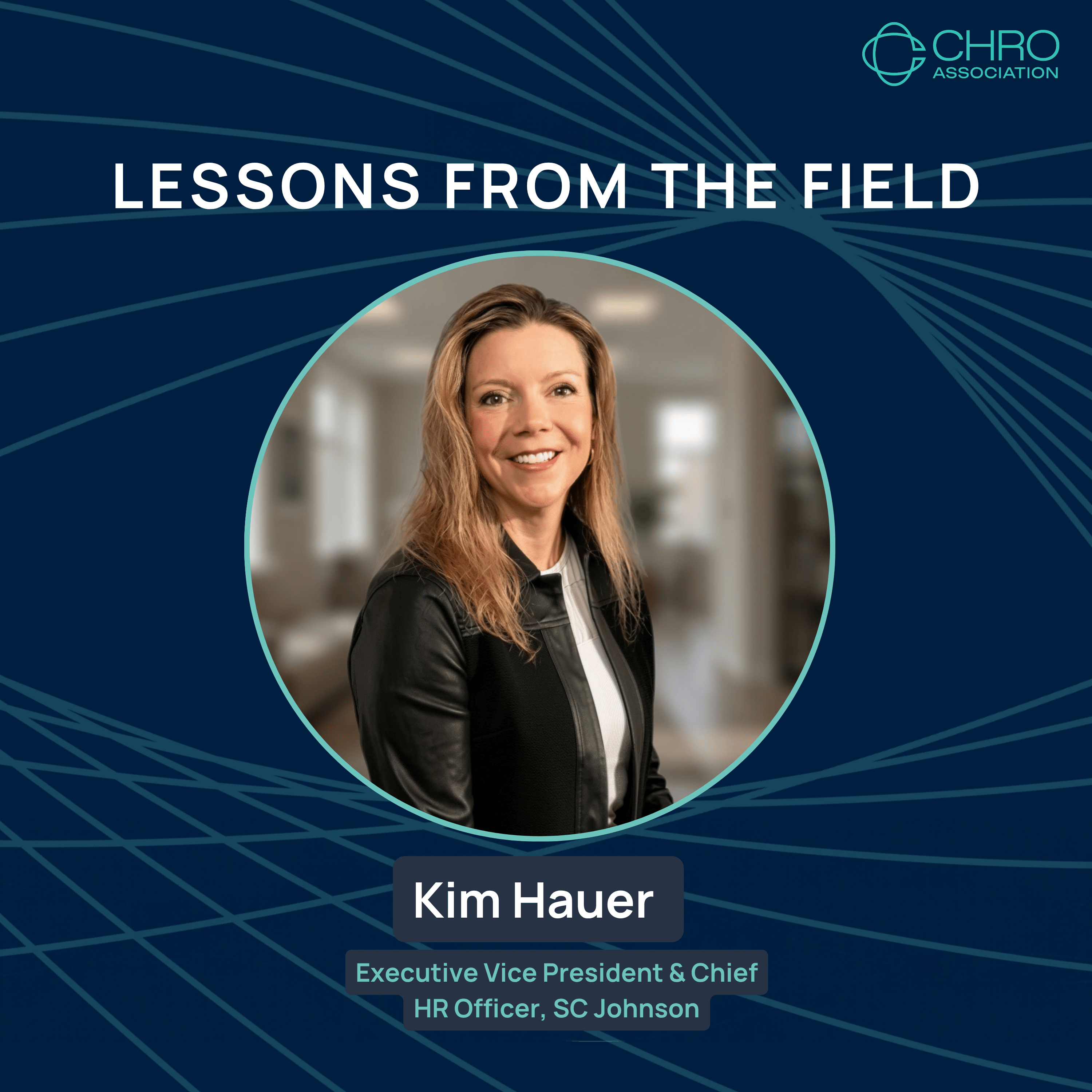
[00:01:13] Speaker C: I'm Ani Huang with Chro association, and welcome to Lessons from the Field. This is our podcast of candid conversations with chros from the world's largest organizations, sharing the stories that shaped how they lead. Our goal is to take the lessons that live inside boardrooms and executive offices and share them broadly so they can inform and inspire the next generation of HR leadership. So let's get into this episode of Lessons from the Field. So proud to welcome Kim Hauer, the Executive Vice President and Chief Human Resources Officer at SC Johnson. Kim, thank you so much for being here.
[00:01:44] Speaker A: Thank you, Ani. It's great to be here.
[00:01:47] Speaker C: So you've been a chro at multiple companies. Take me back to the beginning. What drew you into HR in the first place? I mean, was that a choice you made? Was it something that found you? How did that happen?
[00:01:58] Speaker A: So I started a college internship at Caterpillar in West Lafayette, Indiana. Working in the factory out of necessity. I needed money to pay for school and was just thrilled to have the opportunity. And ironically, I was taking an interviewing class as part of my curriculum, and I had an assignment to interview people that, like, I aspired to be or wanted to learn more about the function.
So I interviewed the HR manager and the marketing manager at the plant.
And much to my surprise, the HR manager took a liking to me and asked if I wanted my next year of internship to be in hr. So I gladly accepted and started my career interviewing production workers to build engines in West Lafayette, Indiana. And the business was growing quite a bit at the time. And I will never forget making my first job offer to a production worker, and I could literally hear his wife cheering in the background as I was making the offer. And it was one of those moments, very naive, of course, because I had no idea the whole role that HR plays. And it's not always the fun things of making job offers, but in the moment, it really touched me about having an impact on, you know, not just other people, but how it made me feel in that moment was very special. So I was hooked, and I've been in HR ever since.
[00:03:12] Speaker C: What an amazing first experience story. That's incredible. My goodness. And so how long you were at Caterpillar then?
From intern?
[00:03:21] Speaker A: Yeah, I spent a couple years as an intern and then almost 20 years on top of that. And I was the head of HR for the or Chro for the last six years of my tenure.
[00:03:31] Speaker C: I love it. What about a moment that changed how you lead? Like a before and after? If you can think of a moment like that, and what made it so formative?
[00:03:39] Speaker A: Yeah, it's somewhat embarrassing, but it was when I was privileged to be offered Chro role at the age of 36, and I was young and I was ambitious, and I really didn't know how overwhelming the role would be. I'd worked in nearly every area of hr, but as you know, moving into that top seat can be a bit overwhelming. And in those early days, I failed to. And I let the calendar run me. I said yes to everything.
I traveled all over the globe. You know, we were 130,000 employees at the time in every region of the world, and I just said yes to everything.
And I had just been on an Asia trip and found myself in the uk.
I was presenting to a group, luckily a small group of employees, and I wasn't feeling well, so I excused myself and luckily one of my direct reports followed me, but I fainted in the hallway. And it was one of those embarrassing but defining moments when I realized I've got to get my head around this and I have to lead and operate differently and take control of my career. I was very fortunate to have a really great mentor at the time who had gone through similar experiences, and he heard about the situation before I was even back in peoria. Illinois, at the time. But we had a long talk about prioritization and how to manage differently. And I set up a system where I could easily see how my time was being spent towards my strategic goals or not. I had the pie chart created every week where I would kind of evaluate, am I working on the things that matter or not? And just got really hard on myself of where I was spending my time. And it changed my life, actually, because I was able to better prioritize my family, my personal things, and learned what was most important. And surprisingly, it took me that long to get to that point, but it really was a defining moment and basically changed the way I work and operate.
[00:05:29] Speaker C: Tell us more about this system. You have to measure how much of your time is going toward your strategic goals. Is it just like you making. Do you have, like a timesheet?
[00:05:38] Speaker A: Well, at the time, I don't do it anymore because I've figured it out at this stage. I've been doing this a long time. But at the time, I had my executive assistant literally code every meeting invite with a bucket of.
I prioritized it. What at the time was based on my goals. And so she would categorize everything, and then I'd get a regular report that showed me where I was spending my time. And it was really insightful because absent that, I just sort of did whatever the speed thing was to do at the moment instead of really proactively saying, no, I need to be working on this. This is most important to adding value to the company. This is where I'm going to drive meaningful work and change. So it just sort of shifted my thinking.
[00:06:17] Speaker C: So did that lead you then? Like, were there certain meetings that then you respectfully declined or delegated to other people?
[00:06:23] Speaker A: Absolutely. Yep.
[00:06:24] Speaker C: Can you talk a little bit about how you've navigated that or a specific sort of area where you were able to add value and influence the strategic direction of the company in maybe ways you didn't expect.
[00:06:38] Speaker A: Yeah, I love that question. Ani and I, when I think about this, I reflect way back in the day where we used to talk about HR needing a seat at the table and, you know, and how important that, thankfully, I think those days are.
[00:06:49] Speaker C: Yeah.
[00:06:49] Speaker A: For the big companies to think back on that. But, you know, in my view, it's always about, you know, you don't get your seat at the table. You earn your seat at the table, and if you add value, good things will come. And I remember switching employers, and at one point, I wasn't necessarily being invited to some of the strategic meetings that I really felt I could add value and make a difference.
And, you know, I'm not the kind of person that's going to like, pound my fist and like, insist on being invited to the meeting.
But in one particular case, we were. The company was working on an acquisition and I wasn't necessarily deeply involved, but I started asking questions and I realized that the deal team had overlooked a pretty significant miss on the benefit valuation and what it was going to mean through this acquisition. And rather than make a big deal, I just sent a note and said, you know, if you don't want me involved in this, this is fine. But I, you know, was looking into it and I think we really need to consider X, Y and Z. And it was interesting because I was still kind of earning my way into the company and I didn't get a response, but I got a call first thing Monday morning which said, kim, we'd like you to be in the deal board meeting, you know, this morning at nine.
Oh my goodness. I've been in those meetings ever since. And so, you know, for me, Ani, it's finding those moments where you do add value, even, you know, outside of our HR function is really important.
I've kind of made it a point throughout my career that, you know, if I don't understand the business and how the business is making money, I'm not going to add any value as an HR perspective because you can't just cookie cutter what we do from one business to the other. You really need to understand the business to understand how you add value. And when you show that, you know, you're asked to be involved in all, all sorts of different things in the business.
[00:08:32] Speaker C: So we, we often hear that we're living through unprecedented times. I'm like, we, we probably should stop saying it. I think they're precedented now. Like, it's the definition of precedent. I mean, I don't. So, okay. We're living in precedented times of extreme change, I think, is what people really mean. Change and complexity. So can you think about a time when you had to lead a significant organizational change? It might not have been necessarily the biggest one externally, but one that really tested you the most internally or had a significant impact on people or, you know, whether inside HR or out and kind of how you, how you held people together through that?
[00:09:10] Speaker A: Yeah, it's a great question and I have a lot of memories on this particular time. And it is when I became Chro at Caterpillar, it was a really interesting organizational shift overall so we had a relatively new CEO at the time. And many of the senior level positions, especially in the technical and functional areas, weren't necessarily led by someone that was an expert in the function at the time. They were good leaders and surrounded themselves with people that understood their functions, but oftentimes they didn't necessarily have experience or grown up in those functions, whether it be hr, it a lot of those disciplines. And our new CEO came in with the view that we needed to have expertise in those core functions. It wasn't good enough just to be a leader. We needed to make sure that we had experts in the field that worked very much to my benefit. And I think that's how I accelerated getting that role probably sooner than I deserved, to be honest. But it was a great opportunity. And. But when I came into the top seat, I quickly realized that almost all my direct reports were sitting in Peoria, Illinois.
We were a global organization with a number of different business units. We were more of a cost center of like, here's your policy and practice business units. Find something you like about it and I'm going to send you the bill. It's kind of how we had operated and that expectation really shifted and it was kind of earn your value or they can go buy their business somewhere else.
So I found myself in a role where not only was it a big step up and I had to learn how to lead, but I had to really shift the mindset of the entire organization of we've got to figure out how to add value, not just deliver the same services that we've always done. So that required a dramatic organizational change from the HR team and making sure I had the right players, that I had good global representation, that I really understood what was happening in the roughly 30 business units that we had at the time and making sure I had the right players with the right mindset and really had to talk. We had a lot of HR teams that were working very independently at the time and not coordinating. And so I instituted the mantra of kind of one hr and we all had to understand how the others worked and really had to change not only a number of people, but the expectation of how we operated. And I learned a lot. It was very difficult. It took a few years to work through that change. But I was really proud of the difference that it made and how I felt the level of respect for the function improved over the years.
[00:11:35] Speaker C: Wow. So would you say, I mean, what, what would be like the one or two biggest learnings if somebody needed to go through that exact thing? Right now that you would tell them and is there anything that to maybe save them some of the pain?
[00:11:47] Speaker A: The one thing that struck me, and when I got the job, I reached out, probably through the. Well, it was HRPA at the time, but the Chro association. And I asked for some good CHRO contacts that I could talk to. And I called, I don't know how many, probably five to ten different CHROs. I asked the question, if you could go back to your first day in the seat, what would you do differently? And almost to a person, they said, I would have made changes to my team sooner.
And it was really helpful insight and I would pass that on to anyone. Not that you probably do have some great people on your team, but the dynamics change, your needs change, and you've got to make sure you have people on your team that are 100% supporting you and know what they need to do and how they need to deliver.
And so I think that was really good advice. And I think for any chro, not waiting to make some difficult choices is really in your best interest because you're going to end up making them anyway. And so the sooner you can work through that and help people understand the vision and what you're going to be driving and make sure you have people on the bus that are aligned with that is really important.
[00:12:53] Speaker C: So I guess maybe sort of in line with that. We've been talking a lot at the association about resilience recently, and I think that word can mean a lot of different things to different people. I think we all were trying to teach our kids resilience. I mean, I know even at my kids schools they've started talking about it.
[00:13:07] Speaker A: I'm like, I don't know if it's
[00:13:08] Speaker C: a good sign that we seem to be needing so much resilience, but I mean, what does resilience look like for you? I mean, what does it look like in practice? And how do you find that in yourself? And maybe even more importantly, how do you show other people that they have resilience?
[00:13:23] Speaker A: Yeah. I'll go back to a similar timeframe where a lot of my learnings came from and the fainting story in the uk, but it was also, you know, not only did I have a demanding job, But I've got two beautiful daughters that need my attention as well. They're 23 and 19 now, but they were much younger when I was going through this. And I don't really know how I came up with this, but my youngest daughter at one point put a stuffed animal in my Suitcase as I was embarking off on one of my trips. And from that point forward, I got in the practice of actually taking the stuffed animal to my team meetings and taking pictures of the food I was eating and different experiences from the trip. And then when I would get home, I would sit down and show them the photos and talk to them about my experiences and the cultural differences and show them on the map where I was and tried to really integrate more and more how my entire ecosystem needs to work together. Because I never believed in work life balance. I think it's more of a how do you be everything you need to be all at the same time? So for me, resilience was about finding ways to bring those worlds together and making sure that I have the. But the own support that I need. And I've just tried to continue that throughout the phases of my career. You know, now I play in a golf league every Thursday night, and I find time to go refresh and do, you know, go on girl trips and do other things. And I think those things are really important when it comes to resilience and making sure that you find that balance. There was the period of time in my career where I didn't do that, and I think finding the space to appreciate the full piece of who we are is really important.
[00:14:55] Speaker C: That's amazing. I don't think I've ever heard any. It really is this whole thing of how do you do the best at work and do the best for your kids? It never occurred to me to somehow integrate those things. You could use the work to help
[00:15:07] Speaker A: connect with your kids. I mean, people at work love hearing about your kids. So to show up and talk about them, it just makes you humble as a leader and shows them that you have a human side to you. And similarly for the kids, what a great opportunity to teach them about the world and what you do. And I know my girls have a great appreciation for the work I do and, you know, aspire to do great things. And I think some of that is because I brought them along the journey with me.
[00:15:32] Speaker C: I love it. Amazing.
So moving on to kind of developing people. I mean, you've talked a little bit about this, but would love to hear about someone that you developed as a leader where you feel like you saw the potential even before they did, and you saw great things and what did you do? How did it happen?
You know, what. What became of that person?
[00:15:53] Speaker A: I won't use the name, but there's a gentleman that I met very early in my career, and I forget how Long I had been at Caterpillar, but I'd been there a while and I had sort of come to the realization that having a master's degree in HR and the best street cred wasn't always the strongest person on our HR team. That a lot of the talent that was really progressing well were people that really had to work hard and like work through life battles in addition to having a good education and being smart at what they do. And I had the privilege of hiring for our HR training program for a period of time. And I hired a gentleman who not only was, you know, going to school full time, but he was a supervisor at Best Buy and working, I forget how many hours a week, but he was really having to be very scrappy to pay for his own, a lot of his own school and to get through those things. And he's probably one of the best hires that I've ever made. And we worked together for many years. We didn't work together quite closely, but I was always kind of watching, making sure he was getting the right career experiences because I always saw the potential.
I'm so impressed with him that I've brought him to SC Johnson and he is a direct report of mine today, actually, I just now am moving him. He's been supporting the headquarter functions and I've just announced that he's going to move into the consumer part of the business as an HR business partner because I really want him to get that commercial business experience as his next role. So he's one example. I could share many, especially at this stage in my career. It's not about me anymore. I really want to make sure that we're developing the next generation of HR leaders and getting people the right experiences. It's more important now than it probably ever has been as the roles continue to change and evolve. But our jobs are tough and complicated and I think we need to be really thoughtful as we develop that next generation.
[00:17:41] Speaker C: So when you say get them the right experiences, I mean go into a little more detail about that. Where have you seen a situation where maybe somebody didn't get the right experiences at the right time?
[00:17:50] Speaker A: For me, it's not about checking the boxes necessarily, but I find as I'm building my leadership team, the more someone could have had experience at the different parts of the model. So HRBP experience, maybe experience in a center excellence to some extent, maybe being in the OPS team, a combination thereof, so that you really have an appreciation for what the different parts of HR do, gives people a level of respect for the function itself, which I think is really important.
I think international experience, if you can get it, is very important. I mean, I know from a personal perspective, you know, I've lived in Belgium and Switzerland. Those were life changing experiences for me. You know, just opening your eyes to a different world and what it means to support a global team and having those experiences makes you that much better as a leader from my perspective. So, you know, you're not necessarily going to get all of those things, but to the extent that you can have talent that's agile, that's willing to take on different assignments, take some tough assignments along the way is really important.
[00:18:52] Speaker C: Yeah, we often hear that. So you know, heads of Total Rewards which are very, it's a very desirable role and you know, difficult to recruit for and all that. But I think sometimes when you do have somebody who's a really great like head of Executive Compensation or head of Total Rewards, chros might be unwilling to move that person because they're so critical, you know, doing what they're doing. But then they don't get, you know, maybe other experiences that might be necessary for them to become say a chro.
[00:19:22] Speaker A: I think that is so true. I actually took the pain of moving my head of Total Rewards to an HR business partner role. I really didn't want to do it selfishly, but it was the best thing to do for her development. So you don't always have to do that. And if you're head of Total Rewards isn't interested in being a chro, then by all means, you know, take advantage. And yeah, those roles, those roles are hard to fill. But I do think is in the spirit of developing our function, sometimes we have to make those tough decisions to do what's right for the long term.
[00:19:53] Speaker C: Actually you hear about that a lot for CEO succession too, that yeah, you know, somebody who's really doing an incredibly important job where they're doing, but they need the experience if they're going to be CEO.
Earlier Ron, you mentioned culture, the culture of a company. And I mean that's another one of those words that can mean different things to different people. But what have your experiences been as a chro in terms of actually measuring culture like in the room or in the company maybe if there's a story you can share about how you do that and how you make changes in culture, it's like such a nebulous thing, I think to a lot of people.
[00:20:28] Speaker A: Yeah, you know, I think culture is one of those things you can't teach culture, you can't you know, you have to experience and live culture. And there's no place that's a better culture than where I'm sitting today, to be very honest. And it's not about the values, words that are on the wall or the pamphlet that describes who we are as a company, but it's how we live and how we think every day and what we do.
Being in a private company, we have the benefit of really looking long term and thinking long term, which really helps with culture. But for me, and just kind of one maybe specific example, we transparently communicate things here very early when decisions are made. You know, we don't wait for the next quarter when something's going to happen, even when we don't know all the answers. So an example, if we're going to do a reduction of some sort, we tell people we're going to do it and we tell people we don't know exactly who's going to be impacted and how they're going to be impacted and why. As soon as we do, we'll let you know. But we're here today to let you know that we need to make some changes. And I will never forget, I think it was in Mexico and we were having that type of conversation, which can be really difficult. And a young woman stood up in the audience and she's like, you know, I've only been with this company for, I don't know, three weeks or four weeks. And she says, I very likely might be one of the people impacted, but the company, she said, I just want to say thank you and applaud you because the last company I was at, they brought us in a room like this and came in and handed out pink slips. And she said, I wasn't one of the people that got the pink slip, but I knew that minute that I was going to leave that company. And so thank you for being transparent with what's happening. And so I think that's just. I could give you hours of examples, but I think those are the. Those stories and examples of experiences and how we treat each other at the company are very, very telling. Companies are very different when it comes to those types of activities.
[00:22:19] Speaker C: Yeah, that's a really good point. Yeah. There's also destruction of culture. You could have a great culture that you then somehow destroy. Do you find that it's the rest of the organization that helps to educate new people about culture? I mean, do they have like a course correction for them if something, you know, seems off?
[00:22:37] Speaker A: What I'm actually working on now. So my boss and I will go out and do values sessions with small groups of employees where we have, you know, a whole set of messaging and stories that we tell. We don't want everybody to go out and do that because the stories would fall apart and not be as meaningful if someone's just reading from a script. But we're actually looking at designating key people in the organization that we know steward the values that could, could do that to get the word out even more. Because I, you know, you're not going to, you're not going to get the value in an E learning program or something like that. On this topic. You really have to be face to face and interactive.
[00:23:13] Speaker C: I know you talked about ways that you like the golfing and, you know, the ways that you refresh and recharge and make sure that you're still able to come back and kind of bring value to the company every day without like, you know, just totally knocking yourself out.
What's been the most challenging for you as a chro and how have you sort of managed that? It sounds like it's actually not work, life, balance or something like that.
[00:23:38] Speaker A: The most challenging for me, there's lots of things that are challenging, I think for me is just the sheer number of stakeholders that we deal with as chros. And you have to wear multiple hats and multiple perspectives all at the same time, whether it be the board, the investors, the employees, the customers. Like, it's just more complex, I think, than a lot of people give it credit for. And you add the family dynamic in my corporate current role and there's just, there's just a lot of stakeholders to balance and make sure, and make sure that you're not over indexing on one versus the other. So something I constantly kind of take a step back and reflect, am I doing the best for my board, am I doing the best for the people, etc. And making sure that I'm paying attention to all those stakeholders. Because it's easy to get if you've got a crisis in one, it's easy to let your eye off that and another. And you really can't afford to do that in these jobs.
[00:24:30] Speaker C: Yeah, yeah. Multi stakeholder management, as Charlie Tharp would say.
[00:24:33] Speaker A: Yes, that's exactly.
[00:24:36] Speaker C: Well, all right, this has been amazing. Last question for you. What is the one lesson from your career so far, the lesson from the field that you hope outlasts you or that you would most want to have passed on to the next generation?
[00:24:49] Speaker A: Yeah, for me, there's lots of them, but I really would encourage people to learn beyond the job.
You know, I think learning beyond the function. And I hope that when I'm in executive meetings that sometimes people don't even necessarily know I'm the HR person. And you know, I'm actually an executive for scj.
HR is my passion and my area of focus, but I think it is an HR professional. If you don't understand the full business and how you make money and how you grow the company and, you know, look at it very holistically, you're going to sell yourself short and the company short. So for me, just be agile, learn, grow, be curious and make the most out of every day.
[00:25:29] Speaker C: I love it. Kim, thank you so much. This has been amazing.
[00:25:33] Speaker A: Thank you, Ani. It's been fun.
[00:25:35] Speaker B: Thank you for listening to Lessons from the Field. We hope today's episode gave you fresh ideas and leadership insights you can apply in your own organization. If you enjoyed this episode, be sure to subscribe so you never miss a conversation. To learn more about the Circle CHRO association and explore additional leadership resources, visit CHRO.org thanks again for listening and we'll see you next time on Lessons from the Field.