Episode Transcript
[00:00:00] Speaker A: Over the course of my career, I've met any number of people who conflated resilience with, like, I worked until I passed out, but I got it done. I was resilient. I was like, that's crazy. You can be in a room making or helping to make a decision around an acquisition, and in that same day, someone could be emailing you about the temperature of the salmon in the cafeteria, and there's everything in between.
I'm duty bound and morally obligated to tell you.
Or have you considered this? Or here's the underbelly. If we take this direction right, you're entitled to your feelings. But watch what you say. Like, that's my internal dialogue. Like, watch what you say.
[00:00:38] Speaker B: Every leader has defining moments, decisions, challenges, and experiences that shape not only their careers, but the way they lead others.
Welcome to Lessons from the Field, a podcast from the Chro Association. In each episode, we sit down with today's leading chros and business leaders to explore the lessons they've learned throughout their careers and the insights that continue to influence how they lead organizations and people.
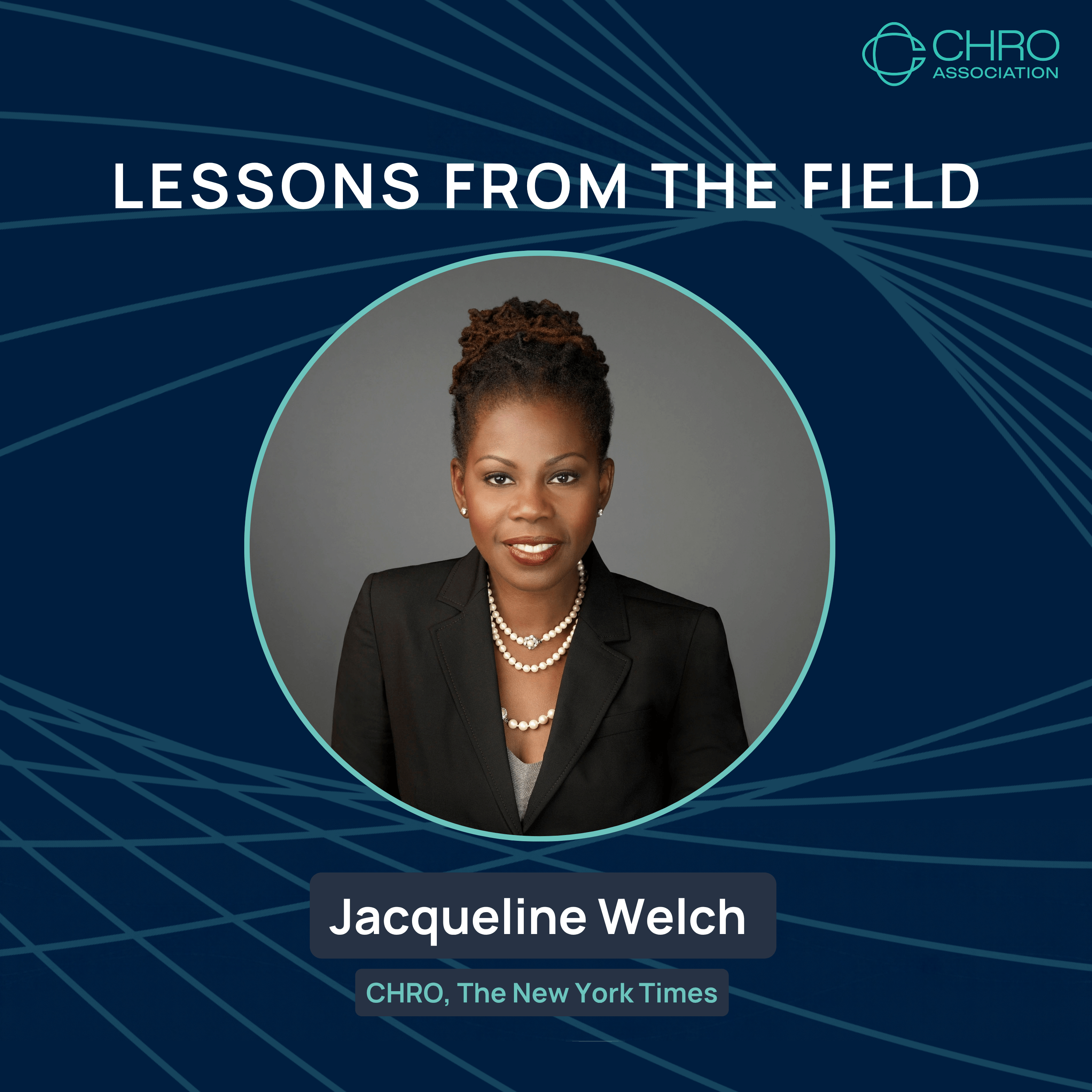
[00:01:07] Speaker C: Hi, everyone. It's Ani Huang from Chro Association. Welcome to Lessons from the Field. Our goal is to take the lessons learned in the boardroom and in executive offices and share them so they can inform and inspire the next generation of HR leadership. Let's get into this episode. Today, we are so proud to welcome Jacqueline Welch, who is the executive Vice president and chro of the New York Times. Jackie, thank you so much for being
[00:01:30] Speaker A: here, for having me. I'm delighted to be here, Jackie.
[00:01:33] Speaker C: I want to give everybody a little glimpse of the person behind the title before we we get started. So I'll ask you what has surprised you most about a career in hr, and can you share a story about something that you didn't expect when you started?
[00:01:47] Speaker A: Absolutely. Such a great opening question. I would say. Generally throughout my career as a chro, the thing that continues to be really surprising is the variability.
So on the one hand, you could be in a room making or helping to make a decision around an acquisition, and in that same day, someone could be emailing you about the temperature of the salmon in the cafeteria, and there's everything in between. So the breadth of the role never ceases to make me go, wow, this is a big job. Just in terms of the complexity of it, in terms of, like, a moment that just, I don't know, sort of elevated in my own mind, the variability was actually walking through the doors of the New York Times with three substantial headwinds it sort of converged simultaneously. So global pandemic, political unrest we haven't seen, or civil unrest we hadn't seen since the 60s predates me, but people compared it to. I haven't seen this in this way since the 60s.
And then political upheaval. And so any of those things individually are difficult. The three of them at the same time. The job got complicated really quickly. I was leaving Freddie joining the New York Times. Many of the issues were the same. We were all terrified. We didn't know what to do with regard to the pandemic. And as I said, the civil unrest and the political landscape changing. And each of those things felt big and massive together. They felt like. I look back on it now and I wonder how any of us made it naturally.
[00:03:25] Speaker C: Speaking of moments, can you talk about a moment that you feel changed, how you lead? So sort of a before and after of a moment that you think back and say, man, that really made it. And maybe it's Covid or maybe it's something else.
[00:03:39] Speaker A: It's actually two different things. One very personal. I have two children. I say children. Those are the wrong words. One's 20 and one is 16. So technically children, yeah, but you know, I've always worked outside of the home, even while we were raising our family.
And, you know, you live your life forward and you understand and appreciate it backwards. And one of the things I appreciate now in a rares is the fact that by the time I started to have children, my dad was fully retired and he took care of our oldest son until he was three.
And then when our younger son came along, he cared for him until he was 2, because you know what? The subsequent kids are a little less uptight about the whole thing. And then we were happy to put him into a more structured learning environment.
And I will tell you, Ani, what that taught me is that there's a huge difference between missing your children and worrying about your children.
I missed my children every day when we were apart, but I never worried about them. And I've never been put in a position where I'd had to hand over my baby to what I was hopeful would be a good care environment.
I certainly didn't appreciate sort of the gift of that and the significant difference between working and being worried versus working and just missing your child. And not that missing your child is not a hard thing, but you can work through that if you're genuinely worried about your child's safety. That's another mindset and that's really sensitized me to Policies with regard to how we support working parents with their child care in a way that without having that experience, I don't know that I would consider all corners of that particular issue. So that was significant for me. That's one the. Again, just thinking about in terms of the human experience at work.
I was at a workplace, I hadn't been there very long. I came in as the chief human resources officer and I went into the restroom and there was a woman in the restroom, open face, crying. And of course you do the human thing. Are you okay? Is everything all right?
And she then narrates and it was a weird conversation because she was talking to me, but that kind of way where you could tell she was kind of working it out in her own head.
Indian woman from India. Her mother had just died and she was doing the math of if I take my bereavement leave and my vacation time and my sick days, because she's thinking about the two, three day journey to get home, whatever period of time it is that she wants to be with her family as they grieve. And then her return trip home. And this particular workplace had a bereavement policy of three days, which is inattentive to a diverse workforce, where for some cultures that's. It's a longer period than that. Some people do want to go back immediately. It's therapeutic to go back to work, but in terms of being an inclusive environment where you try to cast the net as broadly as you can, at least as it relates to the human experience of things like a birth or death, I was like, three days is insufficient.
What are we doing here? So, like, that became like one of my signature pieces of legislation, as it were. And I'm taking it everywhere I go. When I take a job, one of my first questions is like, what's the bereavement policy? And who do I talk to to make it bigger? Like, if that's a decision I can make, here is what I would say we need to do immediately, without even knowing those two things rise to the top of my own mind in terms of like the legacy you want to leave when you occupy a seat like this.
[00:07:03] Speaker C: I think it's very typical of you, Jackie, that both of them are so empathy driven. So that's. That is a such a defining moment for who you are.
[00:07:12] Speaker A: Thank you.
[00:07:13] Speaker C: So then considering more, maybe about just thinking through HR more broadly, One of the things we talk about a lot at the association is how to wield strategic influence in the company as a chro. So that could be Influence over the business direction of the company. It could be over the board, the CEO helping the. The management team. Influence over people decisions could be any type of strategic influence. But can you think of a time when you navigated that and felt like you. You either it was either an aha moment for you of this is how I wield my influence, or just a time when you felt like you successfully did that.
[00:07:50] Speaker A: It's so nuanced, what you're asking Ani and I struggle with the question a little bit because I do. There are certain terms. Trigger is far more dramatic than I mean, but there are certain terms where I go, is that what we really mean?
Influence is one of them. Because I think if you, for me, I'll make it personal.
I don't take jobs and opportunities with the idea of how can I influence. I take jobs and opportunities with the idea of what do I have to add here? What's the point of view that I can uniquely bring and how can I help make the institution better based on that? And that for me is less about influence, because there's a little connotation there of like, power and authority, which I do not ascribe to. And I don't have any judgment of people who do want to be powerful or who do want to exert influence. That's for them, but for me, that's not the motivator. So I say that to say one of the things that I always feel is important to say when my opinion is being sought or where I feel like I have to give an opinion.
And if you've said this to people that have worked with me, they're like, you're talking to Jackie Welch. I am obligated and duty bound to tell you the following.
Here's what I'm seeing that maybe you're not seeing. Or here is how I'm seeing the same set of facts differently. Like, that's my job. My job isn't to ultimately make that decision unless it's in my remit, but my job is to bring that perspective that might otherwise go unnoticed, underappreciated, under processed. And if that's called influence, then okay, then it's influence. But I definitely see it more as what is it that I know and see differently? That's important for everybody at the table to know and see, and they will ultimately do with it what they will. But I have an obligation and I say it. I'm duty bound and morally obligated to tell you, or have you considered this? Or here's the underbelly if we take this direction. Right. And I think the companion to that is I'm not perfect at it, but my intention is to disassociate from outcomes, to not force my will, particularly I would say at the times has really leveled me up in this thinking. The place has been around for 175 years and so there's a certain amount of humility that I bring to that because it's like it was doing just fine before I got here and there's a high likelihood that it's going to be just as fine when I go.
And the only thing that have any sort of the thing for me is like, how do I help make it better while I am here?
And so that. That for me is like the humbling piece of like bring your best thinking. You don't. I don't feel the need to have an opinion about everything. It's like.
But when I have one, then I will insert myself with force to say I'm morally obligated and duty bound to say whatever the thing is.
[00:10:31] Speaker C: I love that. So it's more about where you are bringing value or you think you can add value versus yeah, like wielding influence. That's great.
[00:10:38] Speaker A: I mean there's so many great smart people. I mean I work for a place like if you name a thing, there's an expert in the building on it. Right.
So this idea of being expert in everything for me is like, that's a futile attempt. It's certainly here. But the things I know, I know, the things I feel, I feel, the things I intuit I into it and the things that I go, no, my pattern recognition says this. I am absolutely going to step into that and say, here's the perspective I bring to this issue.
[00:11:05] Speaker C: Can you think of an example that you could share of a time where you. Where you were obligated you were morally bound to share something like that.
[00:11:13] Speaker A: That's a good one. And we'll have to figure out like what. So imagine a scenario, then selection crit, like you're hiring a very senior person.
This has happened. So I'm not sure how to massage it in a way that it's not obvious, but it was a hiring moment where I felt like we were rightly rotating on the technical and functional skills, but at the expense of what we were all naming as kind of like the quirkiness of the person.
And I go, okay, they might can do the job technically and functionally.
Is this someone we want to work with? And you know, you've got all the other people who are technical, functional experts who are making the very strong and right argument and assertions like this is our needle in the haystack. And I go, but yes, are they going to come in and burn the place down, be abusive to the culture and not even like in a mean way, but just because.
And fit's not the right word. It's like, is what they're adding enough to risk what you've already built Sort of the well being of the rest of the team to unpopular view.
[00:12:24] Speaker C: I can see that. I can see that. And I can definitely see the morally bound like aspect of that I'm obligated to share.
[00:12:32] Speaker A: There's nothing on paper that makes this person a bad hire. But there's a lot about who they. How they're packaged in terms of how they will interact with the institution. And it's a fine line because the thing I'm also fond to say is like, it's not culture fit, it's culture ad. Like, who are people that can walk in the door and add and help level up the culture?
But I'm equally vigilant on are we hiring someone that's going to take us in the other direction, who's going to damage the culture or arrest our progress in the culture we say we want to build? And I think those things are important. And of course, you know, at the end of the day the group has to align behind the right hire. But my intention is to put this particular perspective into the mix in terms of the conversation.
[00:13:14] Speaker C: Yeah.
[00:13:15] Speaker A: And then be completely fine if they don't take your advice and not gloat. If you end up being right now
[00:13:22] Speaker C: I would find that difficult. I mean you got to have a little gloating.
Private gloating might be okay.
[00:13:28] Speaker A: I literally am like. And moving on.
Let's not make a thing of it. It's fine. What we know now, we would have been like, it's fine, it's fine.
[00:13:40] Speaker C: As they said. Like, I think it's now like it's been five years in terms of managing through that type of change. We often talk about resilience. This is another word like culture, like influence. That could mean a lot of different things to different people. What does resilience mean to you? And can you talk about a moment where you found resilience that you feel like you found resilience that maybe you didn't know you had?
[00:14:04] Speaker B: Yeah.
[00:14:04] Speaker A: It's so two things I am missing. Certain components like so resilient just. It sounds so much more than I've ever processed myself through Right. Like I don't, I'm a.
I'm such a resilient person.
[00:14:21] Speaker C: Am I resilient?
[00:14:21] Speaker A: Yeah, I don't really see see myself in that way. But so the thing I will say about resilience, one is to make sure we're talking about the ability to see a thing through, but not at all costs. So over the course of my career, I've met any number of people who conflated resilience with like, I worked until I passed out, but I got it done.
I was resilient. I was like, that's crazy because.
[00:14:45] Speaker C: Right.
[00:14:46] Speaker A: Like that. I don't know that that should be your takeaway. I would hope your after action review would reveal places where you could have asked for more help or pushed a deadline or gotten more clarity on your deliverable. But to like work yourself into such a heightened state that you're passed out is, is not resilience, it's kind of full heartedness.
So to me, resilience is going to 12 rounds. Like not everything is going to be perfect. Not every idea is going to have the uptake that you want. You could be mid swim on something and the direction changes or people change their mind about the work. And to me it's being very clear about what is the objective and am I working towards that objective without regard to setbacks or if things fall off the rails or if it ends up getting distorted beyond what your original design is? This thing, you know, your baby you're putting out in the world and is being rejected.
It's the ability to ask the question, is this in the best service of the institution and taking that on board and continuing to move towards that objective. That's resilience more than working yourself to a bone or, or to the bone and being up all night and always on email immediately respond. I mean all those things are great and that's your work ethic, that's fine, but that's not resilience. Resilience is seeing it through in the best interest of the institution in my view.
[00:16:12] Speaker C: That's such a good point about that. Sometimes something that you really, really want to have happen for the organization doesn't happen. And I think that that is, that's a tough role of a leader to help your team through that. I don't know if you have any examples of like something like living one
[00:16:28] Speaker A: right now or we're trying to develop this program and it's like you fall in love with your baby and you bring it out and people are like, your baby's not that cute. And it's like, my baby is. I mean, like, that's a. You know, and you would think I, I was a consultant for many years, and the partners who mentored me would always say, be careful of falling in love with your own ideas because then you can't, you can't disassociate. Right. In a way that's healthy.
I don't want people to hear this and err on the other side of it where they don't care about anything. It's like, care about it enough to get it right for the institution and not necessarily the way you think it should go.
Right. And so I'm in a situation with that right now, or in that right now where we're doing a program for senior most leaders at the Times. And we started off with one set of views of where we were going to go, and then we went to a meeting where it got ripped to shreds. This is not at all. And it was like, okay, it's not it at all.
Let's talk about what is it then?
And you've got to, you got to pivot. Unless now, there have been times where I go, I disagree. I hear what you're saying, but I still stand by my assertion. And that's. I think that's a skill that gets better the more you have the, they threw my baby out with the bathwater. Like, you have to have those experiences and you have to do the after action review because it trains a muscle that every now and then you still do need to push about to go. I hear what you're saying, but let me reassert what I'm saying.
So the development of that skill, I think, is what predetermines good leaders from best leaders.
You can't go after everything. You've got to save that for when it's the thing where you have the most passion, the most intelligence, pattern recognition where you're like, no, no, I'm telling you, that's not the way to think about this. But for everything else, you have to have a certain amount of humility to go, okay, I am going to defer to the wisdom of the group and me.
[00:18:22] Speaker C: Yeah, tough. This is the second time you mentioned After Action Review. Tell us about that. What?
[00:18:28] Speaker A: So I do spend a lot of time thinking about if I had to do it again, what would I do differently? If anything, sometimes with my team, but always with myself, like, there's at least five minutes where I'm like, what went well, what didn't go well? And what will I repeat.
And that has been a tool that's been very helpful to me. So the thing I don't want ever is the same feedback over and over again because it's. Then I'm not growing or I'm not taking signal like something is happening. If at the end of the day you're working as hard as you think you can work and yet the feedback's the same at some point it's like, okay, I can't control the other factors, but I certainly can control my, my own approach and sometimes even taking what I guess some people would consider a risk to say, I'm going to do it differently this time.
Last time I did this, it didn't work out very well. So here's the change I'm making this time around so that, you know, your colleagues can develop a certain amount of trust around, oh, she's taking on board the feedback.
And that opens up the aperture for really good debate around, well, you didn't like it this time, you didn't like it this time. I think you're the common denominator. So let's talk about that. Like, is there a vision you're holding and you're just not saying, because everything, yeah, landing. And that's fine. Just tell me what it is then and we can work from there.
[00:19:44] Speaker C: It's a way to establish trust, basically.
So it can be fun being a chro. But I think it can also be genuinely lonely.
A lot of what you even, you've just talked about in these, just these few minutes, it's like some of that stuff you probably can't necessarily tell too many people about. So how do you manage that? Where do you find support for yourself or grounding or restoration?
[00:20:12] Speaker A: So this is another one of those, like, things I'm missing.
[00:20:15] Speaker C: Okay.
[00:20:16] Speaker A: Like 20 years ago, I just had to. We decided it was longer than that. My oldest is 20 and this predates him. So maybe 25, 30 years ago, me and this woman who's an organizational psychologist we're talking about, we worked at the same place. And I. I don't know what it was that I was telling her. And she said very matter of factly on, on me, she looked me in the eyes and she said, well, you know, you have a low need for social affiliation. It's like, what does that mean?
[00:20:41] Speaker C: Are you a loner?
[00:20:43] Speaker A: Like, am I psychotic? No, but the way she said it, like it was a deadly diagnosis. Right. But she then kind of cleaned it up and went through what that means diagnostically, and I felt better about it. But it was a pivotal moment for me because I am an only child.
I.
My parents came to this country from Central America. So, you know, I was a translator, which is a lonely job, trying to, like, translate where they came from to where we are now and closing those gaps. And that's. That's individual work. I mean, so there's a lot of, like, I look at that. I played sports that were somewhat individual with the exception of crew.
So I was like, oh, okay. So I have to understand that. So why am I saying all these things? Like, the idea of having to process things or accomplish things on my. I'm a classic latchkey kid, Gen Xer. So this idea of lonely to me is like a mythical thing. Like, when I see people who need groups, that seems strange to me. Like, I guess a lot of time going, that's a lot of people. Damn, it's noisy. Are you all having fun? Because it looks. It looks like a lot.
Turns out I'm an introvert. When you do all the tests, like, my energy is alone and plugged in, not out absorbing.
So I don't know that I have loneliness. But what I. So the things that I do, I am pretty dedicated. I've been journaling since I'm 10. I'm 56 now. It's a lot of journals. It takes up a lot of real estate in my home. The number of journals there are.
[00:22:06] Speaker C: You keep them all?
[00:22:07] Speaker A: I keep them all. And they all. On the first page, I write some version of. If you read this and you're written about unfavorably, you should have behaved better.
So you read them if you want to rest, but don't ask me any questions. I wrote it like I experienced it. Right.
And I also end the day with, like, what's tomorrow? So I don't take it to my sleep with me. I'm a fascist about sleep. I can not eat. I can be thirsty to a point. But if you deprive me of sleep, it's just. Nothing works. And so I've built a really good sleep architecture. So those are the things. But I. I also say that knowing that my personal makeup is I don't really feel lonely in my life in any way. And so I don't bring that to work.
[00:22:59] Speaker C: Yeah.
[00:23:00] Speaker A: So I'm not a really a good proxy for that, unfortunately.
Well, I think you find a lot of value in, like, the chro associate. Like, there have been times where it's like, you have a particularly gnarly thing and, you know, a few chros that you trust and you can say, look, this is what's happening.
What do you think? I think that's important. I think you guys provide that space. You have members that have been together now for decades, right?
[00:23:23] Speaker C: So, yes, we have been together a long time. Tell us about the sleep architecture. We need to hear about this.
[00:23:31] Speaker A: So I am an old lady. Like, a great day for me is in the bed at 9 o'. Clock. So literally at 8 o', clock, my alarm goes off and everybody in my household knows she's starting to wind down. So things need to be signed or decisions need to be made. Even the dog knows, like, it's. It's now the narrow path to bed. Right?
[00:23:55] Speaker C: Yes.
[00:23:55] Speaker A: I don't eat past if I. It's hard during the week, but when I have control over it, like if you say dinner at 8, I'm like, I'm hopefully digesting my 6 o' clock dinner by then. So the time that I eat, when I stop drinking, these are all things, you know, the long hot shower, the journaling. Right before. To get anything that's in my head or on my heart out and on a piece of paper is huge.
I'm not a screen person. Like, I'm not watching TV or my screens, for that matter. Phone does not sleep next to me. It has its own station in the kitchen.
[00:24:29] Speaker C: Amazing. You know, I heard there were people like you, but I've never met one.
[00:24:32] Speaker A: So I am one out in the wild. Like, all the things I. They tell you, I take them on board and I'm like, oh, that makes sense. Like, anything going to support me getting a good night's rest. Because without it, it's not good. I'm just not in it. I can't, like, I can't function at the level I want to function if I'm tired.
[00:24:48] Speaker C: Last question for you. What is the one lesson from the field, your career that you hope outlasts you, that you would like to pass on to the next generation?
[00:24:59] Speaker A: So I'll tell it by way of a story very early in my career, and I wasn't yet a chro.
I was working for what was then Anderson consulting on a pretty big deal for the firm with like 30 million plus to the bottom line. And back then, the idea was always you would have a project leader from the firm partnered with a client lead. Right. And this particular client, to this day, I still stand by my characterization of the idea being not a particularly smart one. I think I may have even said the words, that's a dumb idea.
Oh, no, exactly. And he went home Mad, of course. Like, why wouldn't you? Someone calls your idea dumb in public.
And a partner pulled me aside and was like, look, I don't disagree. It's not a well thought out. That's partly why we're here. They're hiring our expertise. He doesn't know what he doesn't know. But you've got to be careful with your loose asides. Like, this is 30 plus million dollars to the bottom line of the firm and if he's angry enough, we could lose this job.
And it really, you know, I'm an English major, so I'm big on words and like finding the right words and saying things in just the right way. And that was the moment where I was like, right. Not just in what you read, but just how you comport yourself. Like you're a leader and anything you say, whether you mean it or don't mean it or said it because you were tired or thirsty or needed a nap, like, it doesn't matter. Once it's out, there's no retracting it. It lands where and how it lands and you could have an adverse risk impact on whatever it is that you're trying to accomplish. And that was hugely enlightening to me. And to this day I'm like, inside voice, inside voice.
Like literally clamp it down. It doesn't need to be said out loud.
[00:26:35] Speaker C: Wow, that's amazing. I think I have that problem myself. So I mean, any tips on how to, you know, stop yourself, maybe pause,
[00:26:46] Speaker A: literally, like, but I can feel my own mercury rising. And that's always like a telltale sign for me.
And so when I feel myself, the animation is going up. That's the, like a gear kicks in. Like, but watch what you say. You're entitled to your feelings, but watch what you say. Like, that's my internal dialogue. Like, watch what you say. And particularly when you're in a leadership position, more so than anything, like the, the more you ascend inside of an organization, I wish this is something people took to heart. Like, I've seen it. I've seen senior leaders say something that in the grand scheme of things, so innocuous and clearly they didn't quote, mean it. It was just, they blew off steam or they were ill informed in that moment, but they're never going to have that audience again. And now you've said it. And people are running in all these different directions because they heard this thing. And you think about all the turmoil that creates and all the confusion and the. Did she, did you hear what she said? No, I didn't. And then people add to it. It grows and grows and you're like, I was there. And what she actually said was and I don't think she meant for you to do anything with it. She was actually processing out loud.
Hugely valuable to me and to how I coach others. Like, yeah, he was really gracious. We're still friends. He was like, hey, listen, let me talk to you for a minute.
[00:27:58] Speaker C: Feedback but incredibly useful. Wow, Jackie, thank you. This has been amazing.
[00:28:04] Speaker B: Thank you for listening to Lessons from the Field. We hope today's episode gave you fresh ideas and leadership insights you can apply in your own organization. If you enjoyed this episode, be sure to subscribe so you never miss a conversation. To learn more about the CHRO association and explore additional leadership resources, visit CHRO.org thanks again for listening and we'll see you next time on Lessons from the Field.